

She had seen a Lyme specialist. An immunologist. A provider who evaluated her for mold illness. She had done the tests. She had the supplements. Nobody could explain why her body kept failing.
After months of working with a new provider, she finally said the thing she had never been able to say before. Her health had collapsed in the years following a sexual assault.
“There it is,” her provider thought. Not Lyme. Not mold. A nervous system that had never come back down.
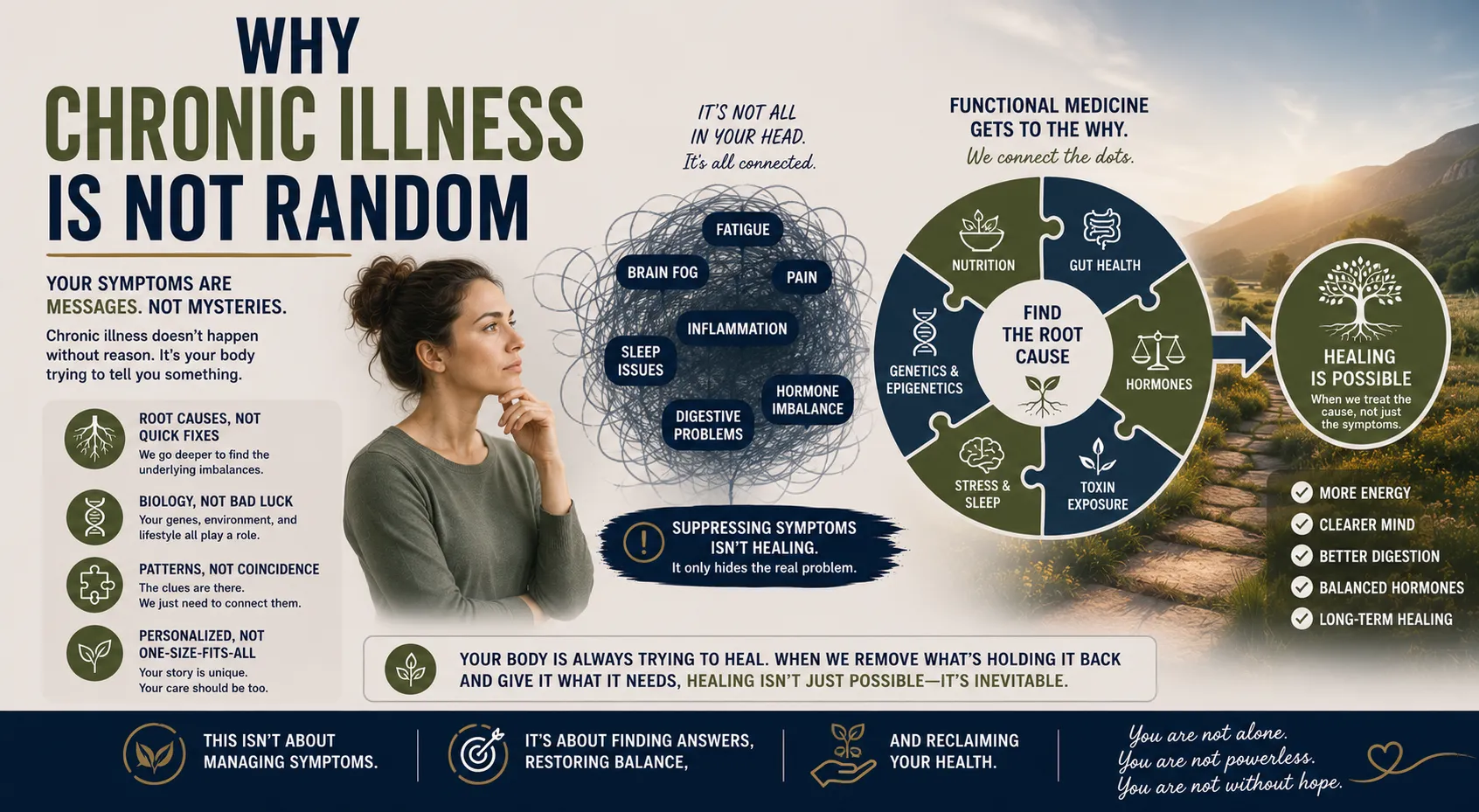
This is not a rare story. It is a specific example of a broader truth: chronic illness is almost never random. It almost always has a trajectory. And that trajectory almost always makes sense once someone takes the time to understand it.
The Body Keeps Score in Ways No Test Can Directly Measure
When people hear “mind-body connection,” they often picture something philosophical. Meditation retreats. Breathwork. The idea that a positive attitude can heal illness.
That’s not what we’re talking about.
The mind-body connection is anatomical. The autonomic nervous system, which controls digestion, heart rate, immune function, breathing, and reproductive function, responds directly to psychological events. It doesn’t distinguish between a physical threat and an emotional one. The same neurological machinery that triggers fight-or-flight in response to a predator triggers it in response to a traumatic event, a sustained abusive relationship, or years of unrelenting work stress.
When the fight-or-flight response stays activated, the chemistry changes. Adrenaline stays elevated. Norepinephrine stays elevated. The body remains in a state of physiological alert that was designed for short-term survival, not sustained living.
Digestion gets suppressed. The immune system gets suppressed. Reproductive function gets suppressed. Blood pressure stays elevated. Sleep becomes impossible or non-restorative.
This is not a theory. These are documented, measurable physiological changes.
Colin Renaud, DC, PA-C describes it precisely: “Trauma and the mind-body connection is not a psychological experience. It’s really a physiological imprint.”
What Happens to the Nervous System Over Time
The nervous system adapts to its environment.
Under chronic stress, it doesn’t simply run at a sustained high level indefinitely. Through neuroplasticity, it rewires. The brain circuitry restructures around a state of heightened threat perception. Small stressors generate large physiological responses. The parts of the brain responsible for emotional regulation and clear reasoning become less active. Memory and focus become impaired.
The person becomes, in a sense, locked in a state of vigilance. Every little thing becomes a big thing. They’re exhausted because their nervous system is burning resources at a crisis rate around the clock.
Over time, this pattern breaks down the adrenal system. The adrenal glands produce cortisol, the primary stress hormone, in response to the ongoing threat signals. Initially, cortisol is chronically elevated. Eventually, the adrenals can no longer sustain that output. Cortisol bottoms out.
When cortisol is chronically low, the downstream effects are significant: blood sugar instability, thyroid suppression, sex hormone dysregulation, severe fatigue, and sleep disruption. The patient can’t get out of bed. Five alarms. Two pots of coffee. Collapsing onto the couch at the end of a work day that required every resource they had just to get through.
Colin Renaud, DC, PA-C describes this endpoint: “The end game of someone that’s gone through something like this is burnout. They’ve just run the body ragged. No gas left in the tank. They’re barely functioning. They barely eat. They’re experiencing very little joy.”
Why the Conventional System Misses This
There’s no lab test for trauma. There’s no diagnostic code that captures “nervous system dysregulation secondary to sustained psychological stress.”
What there is: measurable downstream effects. Cortisol patterns. Hormone dysregulation. Gut dysfunction. Immune suppression. But when a gastroenterologist sees gut symptoms, they look for gut pathology. They don’t ask about the last decade of the patient’s life.
Colin Renaud, DC, PA-C notes: “A lot of patients that struggle with trauma as a physical manifestation of their health concerns are scooted around from specialist to specialist. A lot of times they end up on psychiatric medications, or they’re disbelieved. A lot of gaslighting. It’s all in your head.”
“All in your head” is a misunderstanding, not a diagnosis. The symptoms are real. The physiology driving them is real. The mind-body connection is anatomical. The specialist missing it isn’t wrong about the test results. They’re looking at effects while the cause sits upstream.
There’s also a practical limitation: there’s no pharmaceutical for unresolved trauma. The pharmaceutical model requires a diagnosable condition with a medication-based treatment. Trauma doesn’t fit that structure. So a system built around pharmaceutical intervention has no good tools for it, and therefore little institutional motivation to investigate it.
As Colin Renaud, DC, PA-C observes: “There’s no pill to treat trauma. So who’s doing that work in the mainstream medical system?”
The Accumulation Model of Chronic Illness
Chronic illness rarely starts with a single event. It accumulates.
Think of it as a load-bearing system. The body has a threshold for what it can carry. Each stressor adds weight: an untreated infection, a period of poor nutrition, a job that ran on cortisol and no sleep, an unresolved loss, a toxic relationship, a decade of gut inflammation that was never diagnosed. Individually, the body handles each of these.
Together, they become too much. The system breaks under the combined load.
This is why the person who “seemed fine” until a COVID infection suddenly wasn’t fine, or why a patient’s health collapsed after a car accident that seemed minor, or why someone’s chronic symptoms intensified dramatically during a divorce. The new stressor didn’t cause the illness from nothing. It was the final weight that exceeded the threshold.
The ACE (Adverse Childhood Experience) score is a research tool that makes this concrete. It tallies different types of childhood trauma, including abuse, neglect, and household dysfunction. Research shows that higher ACE scores correlate with significantly elevated rates of chronic disease, substance abuse, and depression in adulthood. The childhood experience shaped the nervous system. The nervous system shaped the physiology. The physiology produced disease decades later.
The disease was not random. It had a history.
What This Means for Treatment
Recognizing that chronic illness has a trajectory changes what needs to be addressed.
Functional medicine can identify the downstream effects with testing: salivary cortisol mapping to show where the adrenal output is in its cycle, sex hormone panels to assess downstream dysregulation, gut markers to evaluate the vagus nerve-mediated dysfunction that often accompanies sustained sympathetic overdrive.
It cannot, on its own, resolve the upstream cause if the upstream cause is a nervous system that has been shaped by years of unresolved trauma. That requires different tools: trauma-specialized therapy, support for nervous system regulation, lifestyle modification that creates conditions for recovery.
What functional medicine can do is provide the physiological foundation. Optimize nutrition so the body has the raw materials to rebuild. Support hormone function so the basic systems have what they need. Improve sleep. Reduce the metabolic burden. Get the cortisol pattern to stabilize.
This doesn’t fix trauma. But it gives the body the conditions in which healing is possible. Without that foundation, even excellent trauma therapy has less to work with.
Colin Renaud, DC, PA-C describes what happens when the connection is finally made: “When she came to the realization that her nervous system had been in this hyperactive state because of unresolved traumatic experience, it started to put her perspective in a different way. It allowed her to look at herself differently. That is part of the healing journey.”
The Type A Problem
High-performing people face a specific version of this pattern.
People who are consistently high-stress, whether from external demands or an internal drive that doesn’t know how to stop, maintain chronically elevated inflammatory markers. The sympathetic nervous system stays in a higher state of activation. Over time, this creates the same physiological consequences as acute trauma, just more slowly.
Research suggests that type A personality patterns may correlate with higher rates of autoimmune conditions, fibromyalgia, IBS, and cardiometabolic disease. The sustained stress response creates sustained inflammatory signaling. The immune system reads that as a continuous threat. Eventually, the regulatory mechanisms fail.
This is not an argument that ambitious people should become passive. It’s an argument that self-care is not a luxury for people who work hard. It’s a clinical necessity. The body runs on resources, and resources are finite.
Colin Renaud, DC, PA-C puts it plainly: “You can’t work 100 hours a week and expect to be healthy. Those two don’t go together.”
How to Start Understanding Your Own Trajectory
If you have chronic illness and you don’t know why, the history is usually more informative than any test.
When did you start feeling this way? What happened in the years before? Was there a period of sustained stress, a loss, an infection that never fully resolved, a job or relationship that ran you down for years? When was the last time you felt genuinely well, and what was different then?
These questions don’t replace testing. But they provide the context that makes test results interpretable. A low cortisol on a salivary panel means more when you know the patient has been running at crisis level for a decade. A disrupted gut microbiome means more when you know the patient went through five years of antibiotic use and chronic gut inflammation following a traumatic period.
Chronic illness is almost never random. It has a history, a trajectory, an accumulation that eventually exceeded the body’s threshold. Finding that trajectory is often the beginning of actually getting better, because once the path is visible, it becomes possible to start walking it in the other direction.
About the Author: This article was written by the clinical education team at Med Matrix, a functional medicine clinic in South Portland, Maine. Med Matrix serves over 3,000 patients with a provider team that specializes in root-cause testing, hormone optimization, and personalized treatment plans.